
Product / Delivery
Hotel delivery robot for room service and amenity runs
Response within 24 hours · Warranty: 12 months
Reviewed by Aobotics Project Team
Quick answer
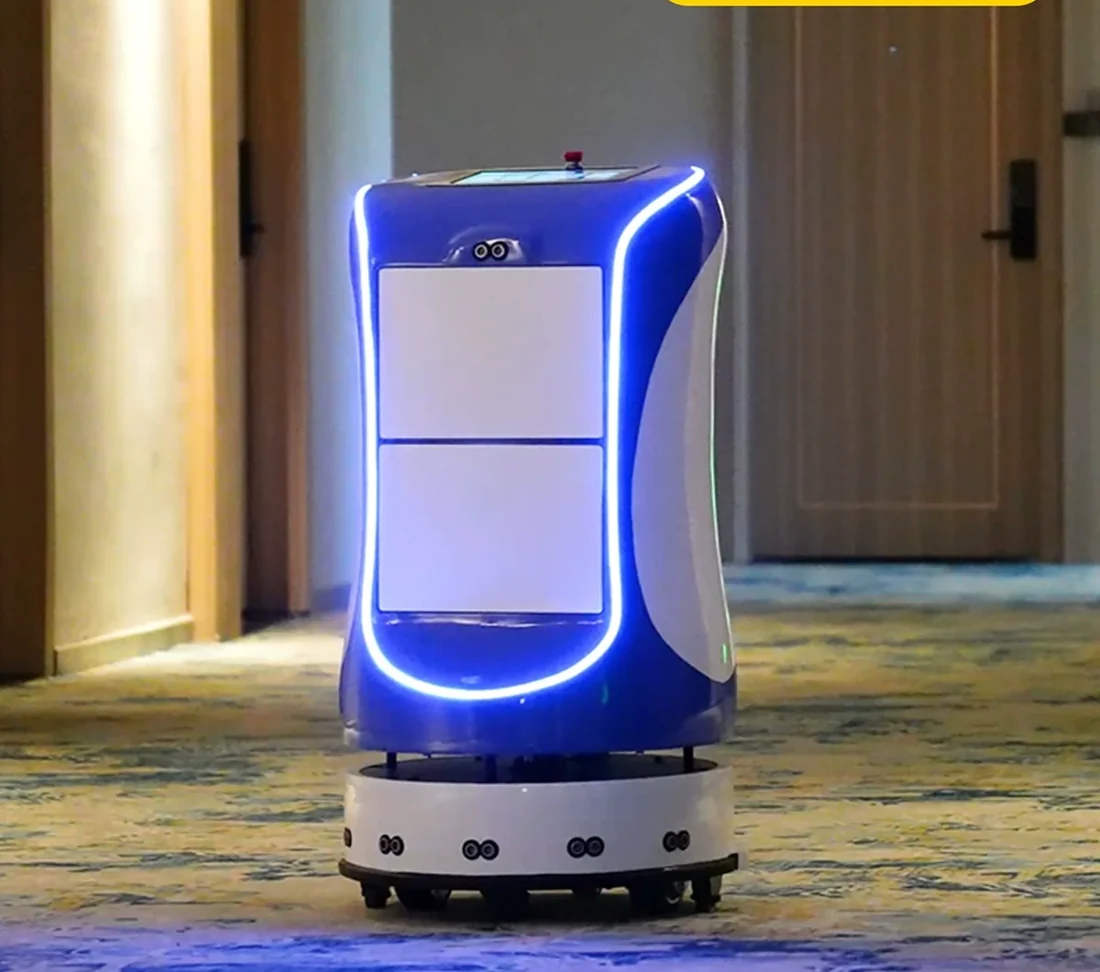
The AOBOTETE hotel delivery robot carries amenities, towels, food and parcels from the service core to the guest floor. It is an autonomous indoor delivery robot for hotel routes, with locked compartments, lift control and room-phone or app notification. Pricing is quoted per configuration and project scope, with a 12-month warranty.
- Compartment configurations
- 2
- Lift control methods
- 3
- Warranty
- 12 mo
- Per project
- Quote
Definition
What does an indoor delivery robot do in a hotel?
It replaces the staff round trip, not the guest interaction.
A delivery robot takes a loaded compartment from the service core to a guest floor, calls the service lift, follows a mapped corridor route and stops at the assigned room. In hotel use it is an autonomous delivery robot for indoor routes — not a sidewalk delivery robot or a warehouse AGV. The guest is notified by room phone, app or the screen on the robot, then releases the compartment with a PIN or room-card tap.
The front desk or housekeeping creates the task. The robot reports back when the compartment is released, if the guest does not answer, or if the lift or route is blocked. The staff member still owns the exception — the robot only removes the walk.
That distinction matters in procurement. A robot that cannot hand an exception back to a named staff role will be bypassed during the first busy shift, and the fleet will sit in the charging bay.
- Typical loads: amenity kits, towels and linen, minibar restock, F&B trays, parcels and laundry bags.
- Typical route: service core → service lift → guest floor → room door → return to charge.
- Typical owner: front office creates the task; housekeeping loads; duty manager handles escalations.
Payload
What can a hotel delivery robot carry?
The compartment layout decides the use case — not the robot’s top speed.
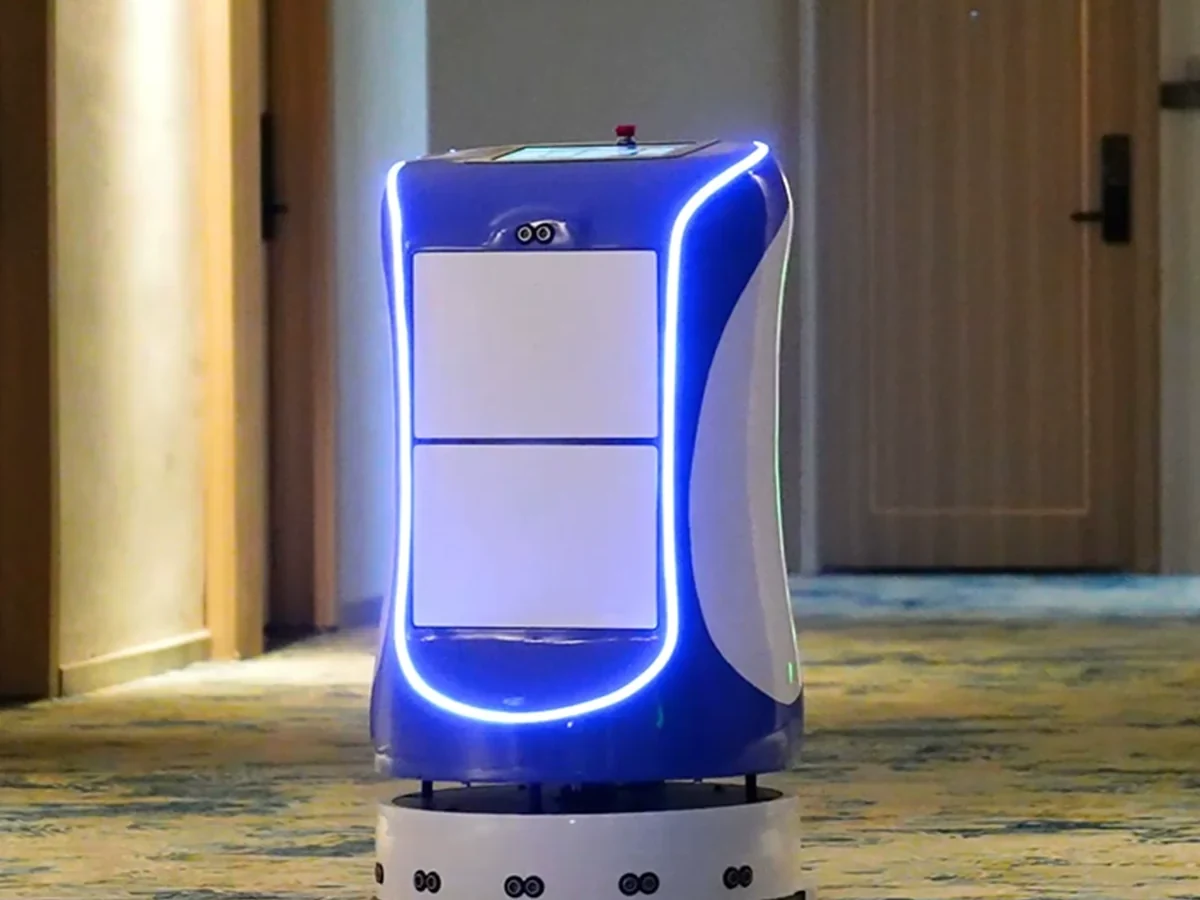
Hotels usually start with amenity and towel delivery because the demand is predictable and the load is light. Food and beverage adds temperature and spill constraints. Parcels add security and size checks. Laundry adds weight and a return leg.
Payload and compartment volume are model-dependent. The confirmed figures are stated on the unit nameplate and in the quotation for the selected AOBOTETE model.
| Load | Typical use | Configuration question |
|---|---|---|
| Amenity kit | Toothbrush, slippers, adapters, baby kit | One locked compartment per task, or shared with a PIN per door? |
| Towels and linen | Extra towels, pillows, bedding | Compartment height and washable liner; who loads at the service core? |
| F&B tray | Breakfast, late-night menu, celebration cake | Flat tray space, spill containment and temperature holding. |
| Parcel / e-commerce | Guest deliveries, courier drop-off | Compartment size, chain of custody and release method. |
| Laundry | Pickup and return bags | Weight, odour separation and a return trip to the laundry. |
| Minibar restock | Water, snacks, retail items | Item-level accountability and PMS posting. |
Workflow
How does a delivery run work?
Six steps, with a named owner at each hand-off.
- 01
Task created
Front desk or housekeeping creates the delivery against a room number in the PMS, the robot console or the staff app.
- 02
Compartment loaded
A staff member loads the compartment, closes the door and confirms the room on the screen.
- 03
Lift called
The robot requests the service lift through the configured method and waits for an empty car.
- 04
Floor transit
The robot exits on the guest floor and follows the mapped corridor route at a reduced speed.
- 05
Guest notified
The room phone rings, the app pushes a message, or the robot screen shows the arrival. The guest releases the compartment.
- 06
Return or escalate
The robot returns to the service core or charging bay. If the guest does not answer, the task escalates to the front desk after the configured wait.
Integration
Can a hotel delivery robot take the service elevator?
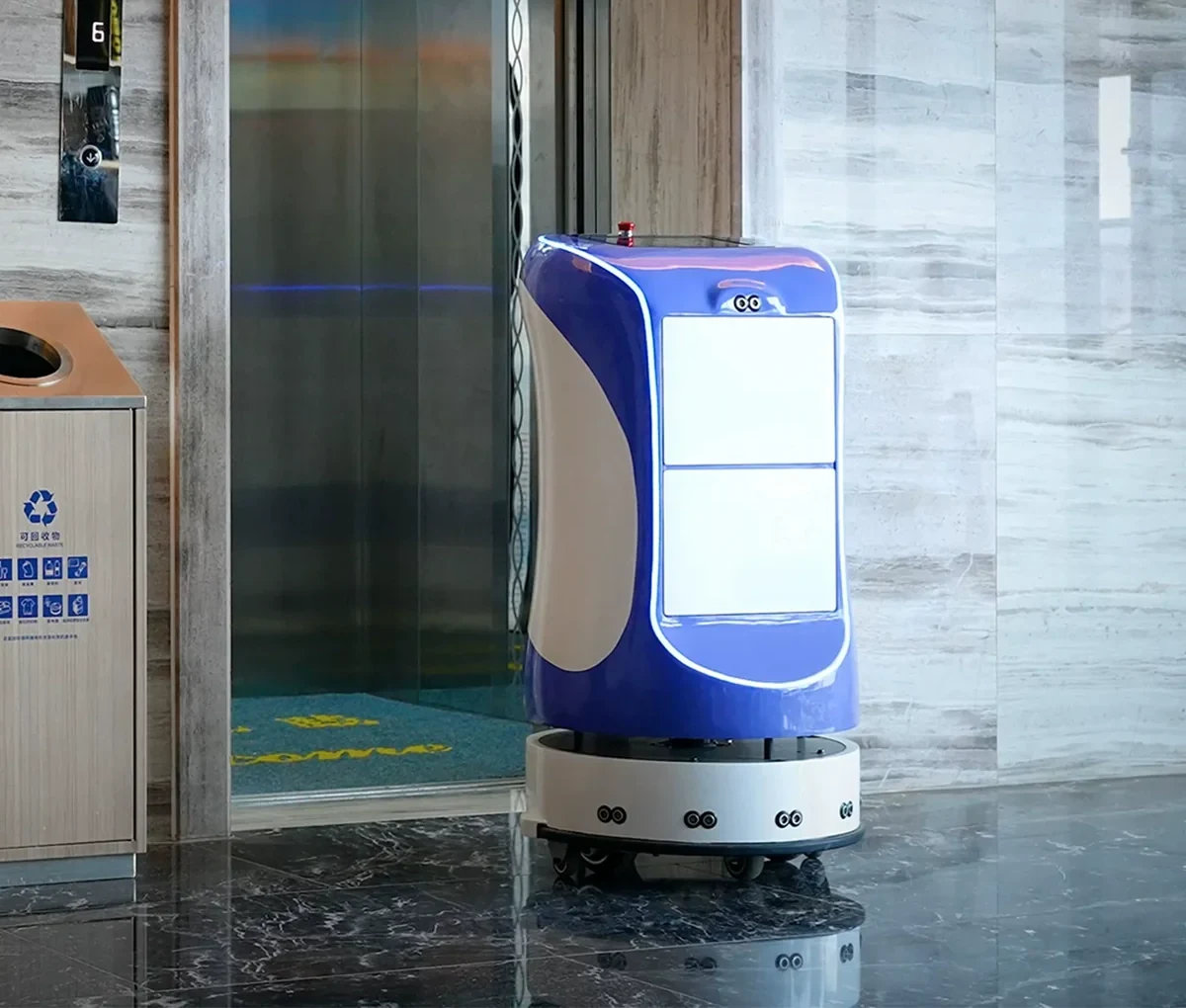
Yes — if the lift controller supports one of three interfaces and the property agrees the priority rule.
The lift is usually the deciding constraint in a hotel project. A robot that can drive a corridor but cannot call a lift will never leave the ground floor. We survey the controller before quoting and select one of three methods.
The method is selected after a lift-controller survey. If none is available, the project uses a manual staff-assisted lift procedure rather than promising automatic control.
| Method | What is needed | Best for | Limitation |
|---|---|---|---|
| Dry contact / relay | Spare relay inputs on the lift controller and a wiring plan | Older controllers with free contacts | No car position or door-state feedback unless additional contacts exist |
| RS485 / serial | Documented protocol, address map and a serial port | Controllers that expose a serial interface | Protocol access may require the lift vendor |
| Building / lift API | API credentials, network path and vendor cooperation | New buildings with a BMS or lift API | Longer approval cycle; needs IT and lift vendor sign-off |
Guest experience
How does the guest know the robot has arrived?
Notification is part of the product, not an afterthought.
The property chooses the notification path during configuration. Room phone via PABX is the most universal in existing hotels. App or QR notification suits newer properties with a guest app. The robot screen is the fallback when the phone is unanswered or the guest is already at the door.
If the guest does not answer within the configured wait, the task returns to the front desk with a clear status. The staff member can call the room, re-send the robot, or deliver manually. The robot never leaves a compartment unlocked in a corridor.
- PABX: the robot triggers a room call with a short message and a release prompt.
- App / QR: the guest receives a push notification and a release code.
- Screen: the robot displays the room and a release button; the guest can also call the front desk.
- Exception: after the wait period, the task escalates to a named front-office queue.
Models
Which AOBOTETE configuration fits your room count?
One platform, two compartment layouts. Choose the layout from the daily task mix.
The parameters below are taken from the factory specification; the final configuration, battery runtime and interface set are confirmed in the quotation.
| Configuration | Best fit | Compartments | Screen | Price |
|---|---|---|---|---|
| AOBOTETE · single compartment | 60–120 rooms; amenity and towel runs | One locked compartment | 10.1-inch touch screen | Contact for quotation |
| AOBOTETE · dual compartment | 120–300 rooms; amenity, F&B and parcel tasks | Two locked compartments | 10.1-inch touch screen | Contact for quotation |
Parameters
AOBOTETE technical parameters
| Parameter | Value |
|---|---|
| Brand / model | Aobo / AOBOTETE |
| Battery | 15Ah lithium |
| Operating system | Android |
| Memory | 8 GB |
| Screen | 10.1-inch touch screen |
| Dimensions | 100 cm |
| Weight | 35 kg |
| Languages | Chinese / English |
| Warranty | 1 year, lifetime maintenance |
| Product type | Hotel delivery robot |
| Payload | Confirmed per configuration (unit nameplate) |
| Compartment volume | Confirmed per configuration |
| Battery runtime | Confirmed per configuration |
| Charging time | Confirmed per configuration |
| Speed | Confirmed per configuration |
| Navigation | Autonomous route following with obstacle avoidance; sensor set confirmed per configuration |
| Lift control | Dry contact / RS485 / building API |
| Network | Wi-Fi; coverage confirmed in the site survey |
| PMS / PABX | Task creation and guest notification; connector confirmed per property |
| Certification | Compliance pack per model and destination |
| MOQ | 1 unit pilot; programme terms from 5 units |
| Lead time | Confirmed in the quotation; typically 4–6 weeks after configuration and deposit |
Capacity
How many deliveries can one robot make per hour?
Use the round-trip time, not a catalogue headline.
A delivery task is not one leg. It includes loading, travel to the lift, waiting for the car, the floor transit, the guest notification wait and the return. In a hotel with a shared service lift, the wait is often the largest variable.
The planning formula is: tasks per hour = 60 ÷ round-trip minutes. With a 12-minute round trip, one robot completes about 5 tasks per hour; with 8 minutes, about 7.5. Use the measured lift wait from the site survey, not a best-case assumption.
These are planning assumptions, not measured results. Peak-hour lift congestion, fire-door routing and guest interaction time can reduce throughput. Confirm the number with the ROI calculator and a site survey.
| Round-trip time | Tasks per hour | Tasks in an 8-hour shift | Tasks in a 10-hour shift |
|---|---|---|---|
| 8 minutes | 7.5 | 60 | 75 |
| 10 minutes | 6 | 48 | 60 |
| 12 minutes | 5 | 40 | 50 |
| 15 minutes | 4 | 32 | 40 |
Fit
Hotel delivery robot vs restaurant tray robot vs waiter robot
Same building, different task and hand-off.
A hotel delivery robot moves a locked compartment from the service core to a guest floor; the guest releases it without a staff member present. A restaurant tray robot moves open trays from the kitchen pass to a table while staff are nearby to load and unload.
The two roles can share a property, but they should not be sold as the same unit. A hotel food delivery robot is usually a room-service configuration: lift control, room notification and a secure compartment. A waiter robot is a dining-room tray runner: tray capacity, a dining-room route and a staff hand-off. Use the task mix to decide whether one platform can cover both or whether a mixed fleet is clearer.
If both tasks are required, use separate units or a mixed fleet with a shared task console. Do not assume a tray robot can cover room delivery without lift control and a secure compartment.
| Task | Hotel delivery robot | Restaurant tray robot |
|---|---|---|
| Primary task | Room delivery of amenities, F&B and parcels | Tray delivery and collection in the dining room |
| Hand-off | Locked compartment; guest PIN or card | Open tray; staff load and unload |
| Route | Service lift, guest floors, room door | Kitchen pass, dining room, table side |
| Notification | Room phone, app or robot screen | Verbal or visual; staff present |
| Best fit | Guest-floor logistics with no staff at the door | Restaurant or hotel F&B with staff on the floor |
Commercial
What does a hotel delivery robot cost?
The unit price is only one line in the project.
The project price is quoted per configuration and scope. It includes the unit and the standard configuration; lift integration, PMS connector work, mapping, training, freight and duties are itemised separately. Spare parts and an extended service agreement are optional. Contact us for a current quotation.
A pilot with one unit is the lowest-risk way to test demand. If the property needs coverage across shifts, two units are usually cheaper than one unit plus overtime, because the second unit also provides redundancy during charging and maintenance.
- Included: unit, standard configuration, mapping support, staff training and a 12-month warranty.
- Quoted separately: lift controller work, PMS/PABX connector, freight, duties, installation travel and spare kits.
- Not included by default: civil works, network upgrades, lift vendor charges and local certification fees.
Frequently asked questions
Frequently asked questions
Response within 24 hours · Talk to an engineer
What is the difference between a hotel delivery robot and a room service robot?
The terms overlap. A hotel delivery robot is the hardware platform; a room service robot is the use case where the guest requests an item to the room. The same AOBOTETE unit can handle amenities, F&B and parcels, but the compartment layout and notification method are configured for the task mix.
Can the robot deliver to multiple rooms in one trip?
A multi-compartment model can carry several tasks in one trip, but each compartment needs a separate release and a clear guest assignment. The control software must prevent a guest from opening another guest’s compartment. Confirm the multi-task logic in the quotation.
Does the robot need Wi-Fi across every corridor?
Yes. The robot needs a stable network path for task updates, lift calls and status reporting. A site survey should check corridor coverage, lift lobby coverage and handover between access points. Dead spots are a common cause of failed deliveries.
What happens if the guest does not answer the door?
After the configured wait, the task returns to the front desk with an exception status. The robot does not leave the compartment unlocked. Staff can call the room, resend the robot or deliver manually, and the event is recorded.
Can it use the same lift as guests?
Most hotels assign a service lift to reduce guest friction and avoid the robot entering a crowded car. If only a guest lift is available, the property needs a clear priority rule and a staff procedure for peak hours. The lift method and rule are agreed during the survey.
How long does installation take?
The schedule depends on lift integration, network readiness and the number of floors to map. Pre-staging and mapping happen before the site visit; the on-site work is focused on lift handshake, route validation and training. The confirmed schedule is part of the project plan, not a catalogue promise.
Is the robot safe around guests and staff?
The platform uses obstacle detection, speed reduction in guest areas and an emergency stop. The property still needs a written rule for corridor behaviour, lift priority and manual override. Safety is a shared operating procedure, not only a sensor specification.
What is included in the 12-month warranty?
The warranty covers parts and labour for the robot platform under normal hotel use. Wear items, accidental damage, network changes and lift-controller modifications are excluded. The exact scope and response process are stated in the quotation.
Can we start with one robot and add more later?
Yes. A pilot unit is the normal starting point. The fleet software should be licensed for expansion, and the lift and network design should leave capacity for additional units. Adding a second unit later is usually simpler than upgrading a single unit to cover two shifts.
Related pages
Related pages
Room service robot
Guest-triggered delivery workflow and call methods.
Learn moreHotel robot price
How a quotation is scoped, cost factors and landed-cost documentation.
Learn moreElevator integration
Dry contact, RS485 and API compared.
Learn moreROI calculator
Estimate fleet size and payback.
Learn moreAobotics
Send the room count and lift type
We will reply with an AOBOTETE configuration, a capacity estimate and a quoted price within 24 hours.
- Response within 24 hours
- Talk to an engineer
- Warranty: 12 months
Tell us about your property
Share your property and the task. We reply with a configuration and a scoped quotation within 24 hours.