
Guide / Integration
Hotel robot elevator integration: three methods
Response within 24 hours · Warranty: 12 months
Reviewed by Aobotics Project Team
Quick answer
A hotel robot can call a lift by dry contact, RS485 serial protocol or a building/lift API. Dry contact is the cheapest and least informative; RS485 reads car position and door state; an API gives the best observability but needs vendor cooperation. The method is chosen after a lift-controller survey.
- Integration methods
- 3
- Survey before quote
- 1
- Test record per lift
- 1
- Warranty
- 12 mo
Why it matters
Why is the lift the hardest part of a hotel robot project?
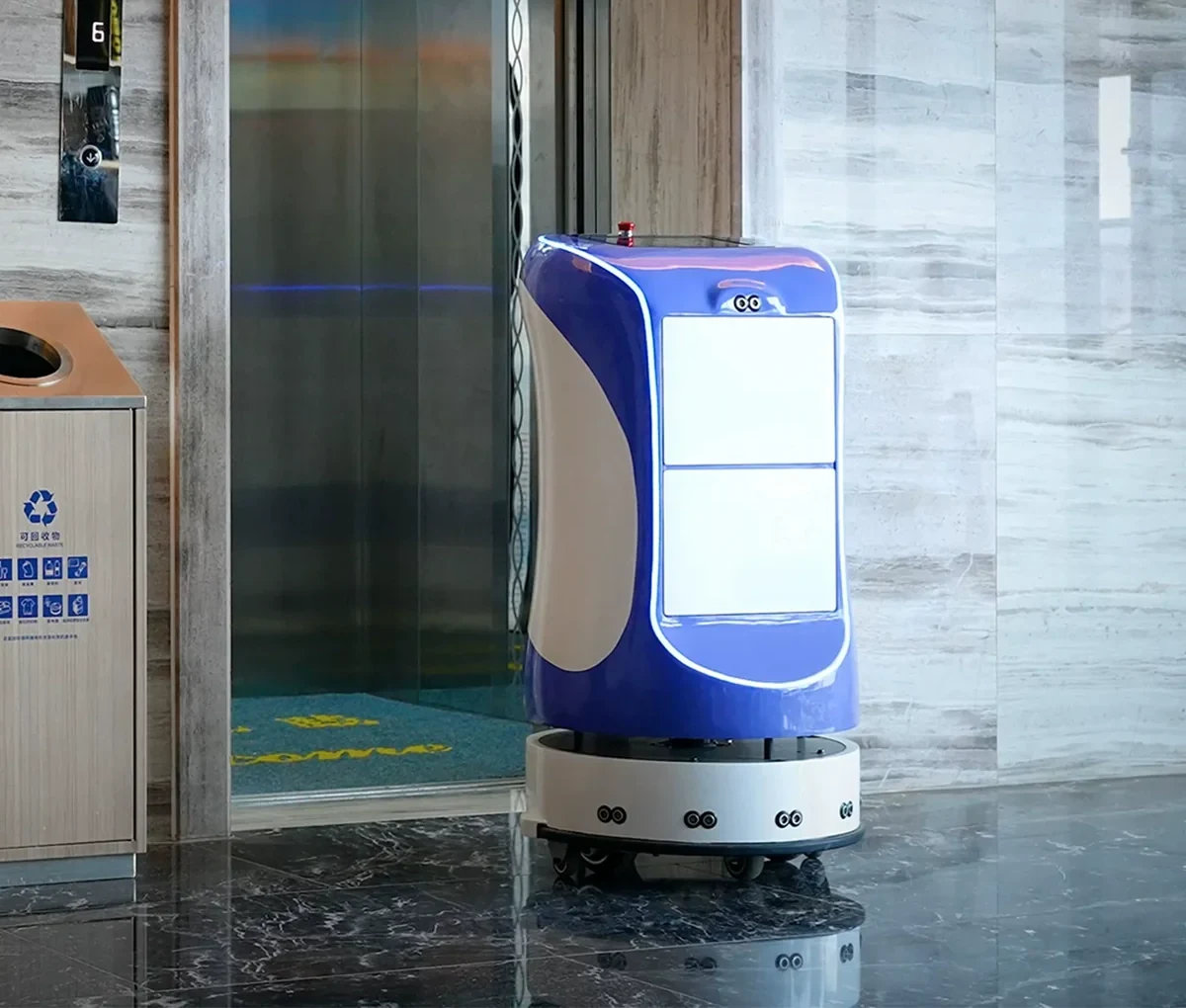
The robot can drive; the building decides whether it can travel.
A delivery robot can map a corridor in hours. A lift integration can take weeks because it involves the lift vendor, the controller, the fire strategy and the property’s IT and engineering teams. The lift is the single most common reason a pilot slips.
The survey must answer three questions: which interface is available, who is allowed to use it, and what happens when the lift is busy, in fire mode or under maintenance. If those answers are not written down, the project does not have a lift plan.
Methods
What are the three lift control methods?
Cost and observability trade off directly.
Some controllers support more than one method. Choose the simplest method that gives the feedback the operating procedure needs.
| Method | What the robot can do | What is needed | Main limitation |
|---|---|---|---|
| Dry contact / relay | Call a floor, open/close door if wired | Spare relay inputs and a wiring plan | No position or door-state feedback |
| RS485 / serial | Call, read car position and door state | Protocol document, address map, serial port | Protocol access may need the lift vendor |
| Building / lift API | Call, read status, receive events | API credentials, network path, vendor support | Longer approval and security review |
Survey
What should the lift survey record?
A one-page record prevents most integration surprises.
- Lift vendor, controller model, firmware version and service contact.
- Available interfaces: relay inputs, serial port, API, BMS gateway.
- Whether the service lift is dedicated or shared with guests.
- Fire-mode behaviour and the rule for robot use during an alarm.
- Door-open time, floor list and any restricted floors.
- Who is allowed to change the controller configuration.
- The test procedure and the person who signs the record.
Failure modes
What happens when the lift fails?
Design the fallback before the pilot.
| Failure | Robot behaviour | Staff action |
|---|---|---|
| Lift busy at peak | Wait for the configured timeout, then requeue | Use the staff lift or delay the task |
| Door does not open | Retry once, then abort and return | Check the lift, deliver manually |
| Fire alarm | Stop lift use, return to the service core | Follow the fire procedure |
| Controller offline | Stop lift tasks, keep corridor tasks | Call the lift vendor |
| Network loss | Finish the current task if safe, then stop | Manual delivery until restored |
Acceptance
What should the lift test record include?
Test the exception, not only the happy path.
The acceptance test should cover a normal call, a busy lift, a door obstruction, a fire-mode simulation (with the lift vendor) and a network loss. Record the time, the floor, the result and the person who verified it.
A test record that only shows one successful call is not evidence of an integration. Ask for the exception cases and the retry behaviour.
Frequently asked questions
Frequently asked questions
Response within 24 hours · Talk to an engineer
Can the robot use a guest lift?
It can if the lift is integrated and the property accepts the guest-flow impact. Most hotels prefer a service lift. If only a guest lift is available, define an off-peak schedule and a priority rule, and measure the guest friction during the pilot.
Do we need the lift vendor’s permission?
Yes, for any change to the controller configuration or the use of a vendor API. The property should confirm the permission in writing before the integration work starts. A third-party integration without vendor support is a maintenance risk.
What if the lift has no spare relay?
The options are to add a relay module, use a serial interface if available, or use a manual staff-assisted procedure. The survey should state which option is viable and who pays for it.
How long does lift integration take?
It depends on the interface and the vendor. A dry-contact job with spare relays can be quick; an API integration may need a security review and a vendor change request. The schedule is confirmed after the survey, not before.
Can one robot control two lifts?
Yes, if both controllers are integrated and the fleet software can choose the best car. In practice, each lift is a separate integration and test. Start with one lift and expand after the pilot.
What happens in a fire alarm?
The robot must stop using the lift and return to the service core or a safe location. The lift controller’s fire mode takes priority. The property’s fire procedure must include the robot and be practiced with the staff.
Is a wireless lift interface acceptable?
Only if the lift vendor and the property accept it and the failure behaviour is documented. Wireless adds a failure point; a wired interface is preferred for a permanent installation.
Aobotics
Send the lift controller details
We will tell you which method is viable and what the lift vendor needs to provide.
- Response within 24 hours
- Talk to an engineer
- Warranty: 12 months
Tell us about your property
Share your property and the task. We reply with a configuration and a scoped quotation within 24 hours.