
Product / Room service
Room service robot for guest-requested deliveries
Response within 24 hours · Warranty: 12 months
Reviewed by Aobotics Project Team
Quick answer
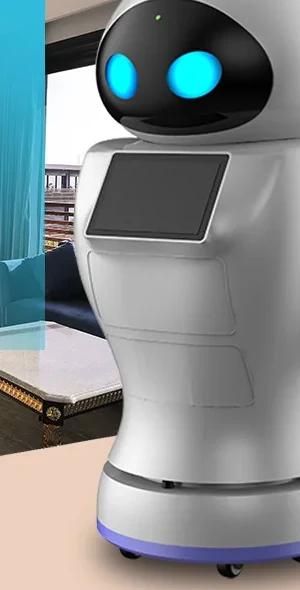
A room service robot delivers guest-requested items — amenities, towels, food, drinks and parcels — from the service core to the room door. It is a common hotel service robot configuration: requests arrive by room phone, guest app or PMS; the robot calls the lift, notifies the guest and escalates a no-answer task to the front desk.
- Request channels
- 3
- Tasks per hour, planning range
- 5–7.5
- Warranty
- 12 mo
- Per project
- Quote
Definition
What is a room service robot?
A delivery robot configured around guest-initiated tasks.
A room service robot is the guest-facing use case of a hotel delivery robot. The guest asks for something — an extra towel, a phone charger, a late-night meal — and the request becomes a robot task instead of a staff walk.
The difference from a generic delivery robot is the request channel and the guest hand-off. The robot must know which room, which guest, which compartment and which notification path. It must also know when to stop trying and return the task to a human.
- Request channels: room phone via PABX, guest app or QR code, PMS guest request, or front-desk entry.
- Hand-off: PIN, room-card tap or staff release, depending on the property policy.
- Exception: no answer, wrong room, spill, lift fault or network loss.
Food delivery
Can a room service robot deliver food?
Yes — for sealed or covered food, not open tray service.
A hotel food delivery robot is a room service robot configured with a food-safe compartment and a cleaning routine. It carries covered trays, packed meals and drinks to the guest floor; the guest releases the compartment at the door.
It is not a waiter robot. A waiter robot runs open trays in a dining room with staff at the table. If the task is restaurant tray service, use a tray runner; if the task is room delivery, use a room service robot with lift control and a closed compartment.
Hot food, open drinks and table-side plating need a different platform and a staff hand-off. Confirm the food-safe configuration and cleaning routine in the quotation.
Workflow
How does a guest request become a robot task?
Three channels, one queue.
Not every hotel needs all three channels. Start with the channel the front desk already uses; add the others after the pilot.
| Channel | Guest action | Property requirement | Best fit |
|---|---|---|---|
| Room phone / PABX | Dials a service key or the front desk | PABX integration and a task queue at the front desk | Existing hotels with a traditional phone system |
| Guest app / QR | Selects an item and confirms the room | Guest app or in-room QR, plus a task queue | Newer properties with a digital guest journey |
| PMS request | Front desk or housekeeping enters the request | PMS connector or a staff console | Properties that want one record in the PMS |
| Staff console | Staff member creates the task manually | Tablet or desktop console | Pilot phase and exceptional requests |
Service level
How long does a room delivery take?
Plan from the lift wait and the floor route.
A delivery to a mid-floor room typically involves loading, a lift call, one floor transit and a guest notification wait. The controllable part is the route and the lift priority; the uncontrollable part is how quickly the guest opens the door.
For service-level planning, use the measured round-trip time from the pilot. A 10-minute round trip supports about six tasks per hour; a 15-minute round trip supports about four. The guest-facing promise should be a window, not a precise minute.
These are planning assumptions for a single unit. Peak-hour lift congestion and long corridors reduce throughput; confirm with the site survey and the ROI calculator.
| Round-trip time | Tasks per hour | Practical promise |
|---|---|---|
| 8–10 minutes | 6–7.5 | Delivered within 15 minutes outside peak hours |
| 11–13 minutes | 4.6–5.5 | Delivered within 20 minutes outside peak hours |
| 14–16 minutes | 3.8–4.3 | Delivered within 25 minutes; staff fallback at peak |
Guest hand-off
How does the guest receive the item?
The release method must match the property’s security policy.
The simplest hand-off is a PIN shown on the room phone or guest app. The guest enters the PIN on the robot screen and the compartment opens. A room-card tap is faster but requires a card reader on the robot and a PMS or lock-system integration.
If the guest is not at the door, the robot waits for the configured period, then returns the task to the front desk. It does not leave the compartment open. Staff can re-send the robot, call the room or deliver manually.
- PIN: works with any phone; no card reader needed.
- Room-card tap: faster for the guest; needs card technology and integration.
- Staff release: used for VIP, accessible rooms or when the guest asks for privacy.
- No-answer: escalate after the wait period; record the outcome.
Fleet sizing
How many room service robots does a hotel need?
Demand = rooms × requests per room per day × robot share.
Start with the current request volume from the front desk log. If a 120-room hotel handles 40 room deliveries per day and the robot can take 60% of them, the robot demand is 24 tasks per day. At 6 tasks per hour and an 8-hour active window, one robot can cover 48 tasks — enough for the pilot, with spare capacity for peaks.
Add a second unit when the property needs coverage across two shifts, when the lift wait is long, or when the robot must charge during the service window. Redundancy is part of capacity, not a luxury.
| Input | Value | Note |
|---|---|---|
| Rooms | 120 | Property data |
| Room deliveries per day | 40 | Front desk log or estimate |
| Robot share | 60% | Pilot target |
| Robot tasks per day | 24 | 40 × 60% |
| Tasks per robot per shift | 48 | 6 per hour × 8 hours |
| Robots for the pilot | 1 | With peak cover from staff |
Parameters
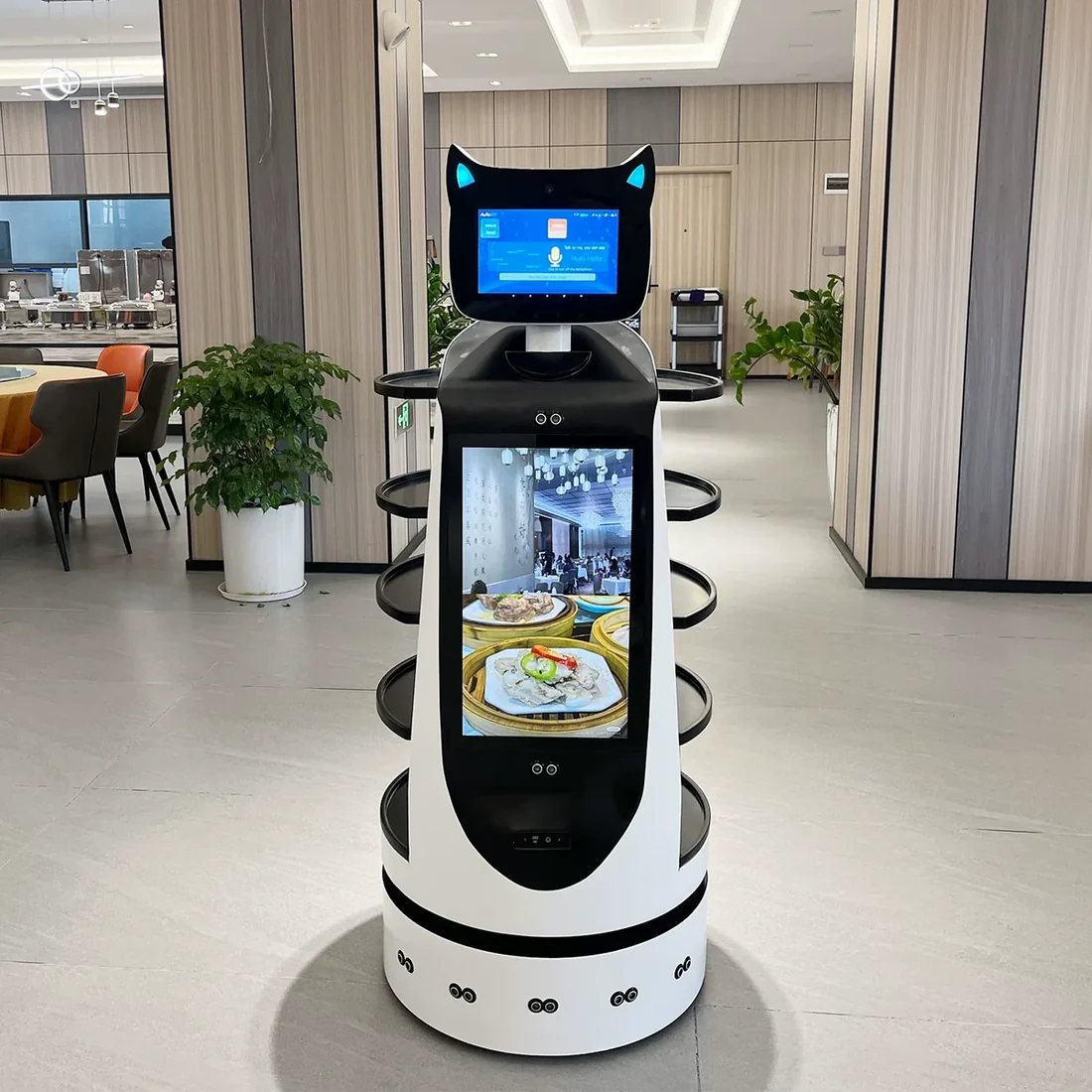
AOBOTETE room-service configuration
The delivery platform, configured for guest-requested room delivery.
Values marked “confirmed per configuration” are verified on the unit nameplate and in the quotation. We do not publish a guessed number where the factory has not confirmed the value.
| Parameter | Value |
|---|---|
| Brand / model | Aobo / AOBOTETE |
| Product type | Room service delivery robot |
| Payload | Confirmed per configuration (unit nameplate) |
| Compartment volume | Confirmed per configuration |
| Compartments | Single or dual locked compartment |
| Screen | 10.1-inch touch screen |
| Battery | 15Ah lithium |
| Battery runtime | Confirmed per configuration |
| Charging time | Confirmed per configuration |
| Speed | Confirmed per configuration |
| Navigation | Autonomous route following with obstacle avoidance |
| Lift control | Dry contact / RS485 / building API |
| Network | Wi-Fi; coverage confirmed in the site survey |
| PMS / PABX | Task creation and guest notification; connector confirmed per property |
| Dimensions | 100 cm |
| Weight | 35 kg |
| Languages | Chinese / English |
| Warranty | 12 months, lifetime maintenance |
| MOQ | 1 unit pilot; programme terms from 5 units |
| Lead time | Confirmed in the quotation; typically 4–6 weeks after configuration and deposit |
Limits
What can a room service robot not do?
Be explicit before the pilot, not after.
- It does not enter the room, unpack the tray or serve the guest.
- It does not make change, take cash or process a payment at the door.
- It does not replace a room-service waiter for hot food that needs plating or presentation.
- It does not resolve a guest complaint; it hands the task back to a staff member.
- It does not work reliably without lift access, network coverage and a mapped route.
A clear scope protects the pilot. Properties that expect the robot to replace the whole room-service interaction usually report disappointment; properties that use it for the delivery leg report time savings.
Frequently asked questions
Frequently asked questions
Response within 24 hours · Talk to an engineer
Can the robot deliver food and drinks?
Yes, with the right compartment configuration. Trays need a flat surface and spill containment; hot food needs a holding temperature that is confirmed for the model. The property should define which menu items are suitable for robot delivery and which still need a waiter.
Does the guest need to install an app?
No. The room phone or a QR code on the robot can carry the notification and the release code. An app is optional and usually only worth adding when the property already has a digital guest journey.
Can the robot call the room phone?
Yes, when the PABX exposes a call-trigger interface or the integration layer can place a call. The exact method depends on the PABX model and the property’s telephony policy. If a call trigger is not available, the robot screen and app notification remain.
How is the compartment kept secure?
The compartment stays locked until the assigned guest enters the release code or a staff member opens it. The task record shows who loaded, who released and when. The property should also define a policy for unclaimed items.
What if the robot meets a guest in the corridor?
The robot reduces speed, keeps to the mapped route and stops if the path is blocked. The property should publish a short corridor etiquette rule for guests and staff, and mark the service route where possible.
Can one robot serve two wings or buildings?
Only if the route is connected and the lift or door interfaces support it. Outdoor paths, separate lift banks and fire doors add cost and failure points. A second unit is often cheaper than a long, fragile route.
How much does a room service robot cost?
The unit price is quoted per configuration and depends on model and configuration. Lift integration, PMS/PABX work, freight, duties and spare parts are quoted separately. A single-unit pilot is the lowest-risk starting point.
What training do staff need?
Front desk needs task creation and exception handling; housekeeping needs loading and compartment checks; duty managers need escalation and manual override. Training is part of the handover and is reinforced during the pilot week.
Related pages
Related pages
Aobotics
Send your room-service volume
Tell us the daily request count, floors and lift type. We will size a pilot and reply with a configuration.
- Response within 24 hours
- Talk to an engineer
- Warranty: 12 months
Tell us about your property
Share your property and the task. We reply with a configuration and a scoped quotation within 24 hours.