Fundamentals
What Is a Hotel Robot? Types, Costs and Realistic Use Cases
A plain-language guide to hotel robots: what they do, the seven main types, what they cost in 2026, where deployments fail, and how to choose a first project.
Quick answer
Seven robot types cover hotel work. AOBOTETE uses a 10.1-inch screen and a 15Ah battery; every unit is quoted with a 12-month warranty and a 24-hour response. Start with delivery when the task is frequent and measurable.
On this page
A hotel robot is a mobile service unit that performs repetitive indoor tasks — delivering amenities, guiding guests, carrying luggage or cleaning floors — on a mapped route, often with lift and PMS integration. It is not a humanoid replacement for staff. It is a task machine with a narrow job that either saves walking time or improves the guest’s first thirty seconds.
This guide explains the category in plain language: what the machines do, which types exist, what they cost, and where projects go wrong. It is written for hotel owners and operators who need a decision, not a catalogue.
What is a hotel robot?
A hotel robot combines a mobile base, a sensor stack, a task interface and a power system. The base moves; the sensors map and avoid; the interface lets staff or guests create a task; the power system determines how long the unit can work before it returns to charge.
The category is narrower than the words suggest. An industrial AGV, a robot vacuum for a home and a toy robot are not hotel robots even when they move autonomously. A hotel robot is designed for carpet, marble, lift lobbies, guest corridors and mixed human traffic. The hotel service robot overview explains the boundary; the glossary defines the navigation and integration terms.
What can a hotel robot actually do?
Most hotel robots do one of seven jobs:
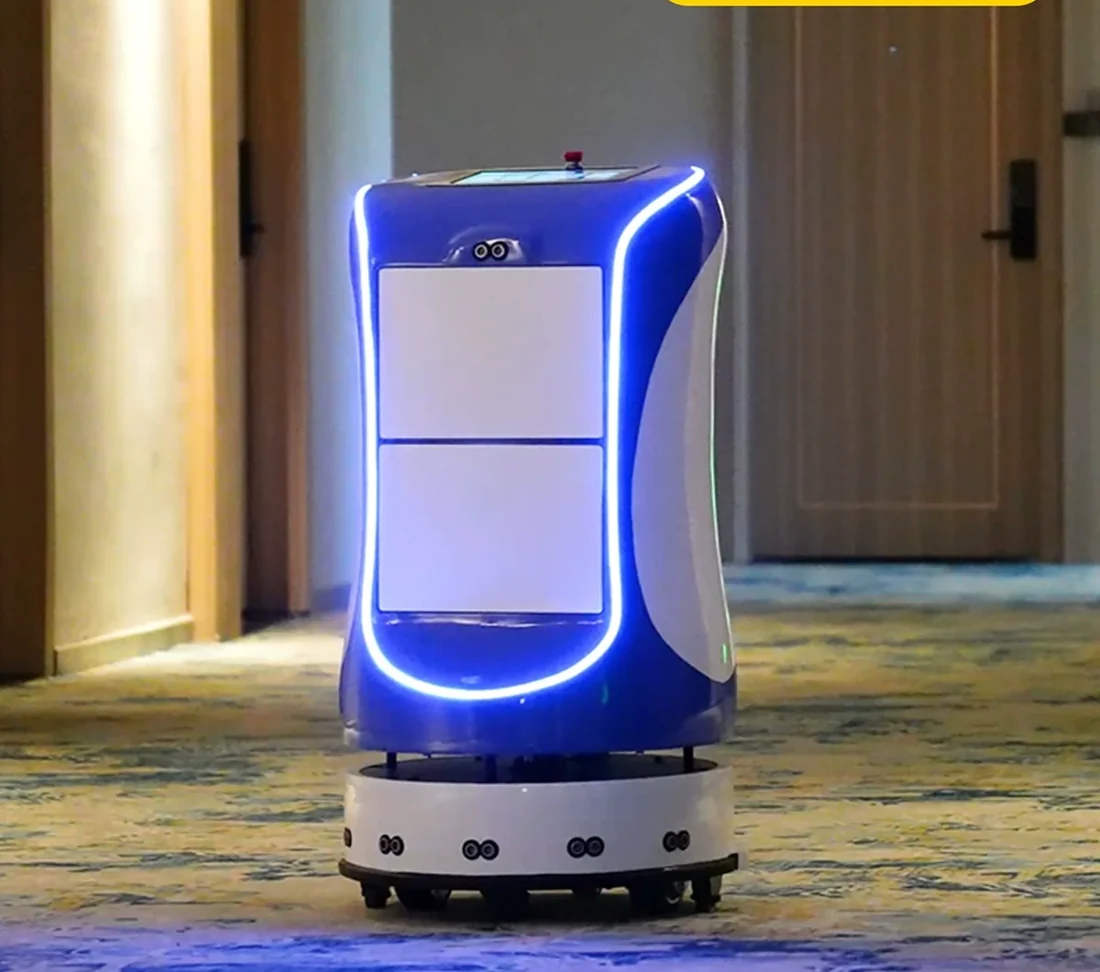
- Room delivery — towels, water, amenities, adapters and baby kits from the service core to the guest floor.
- Guest-triggered room service — the guest calls the room phone or scans a QR code, and the robot brings the item.
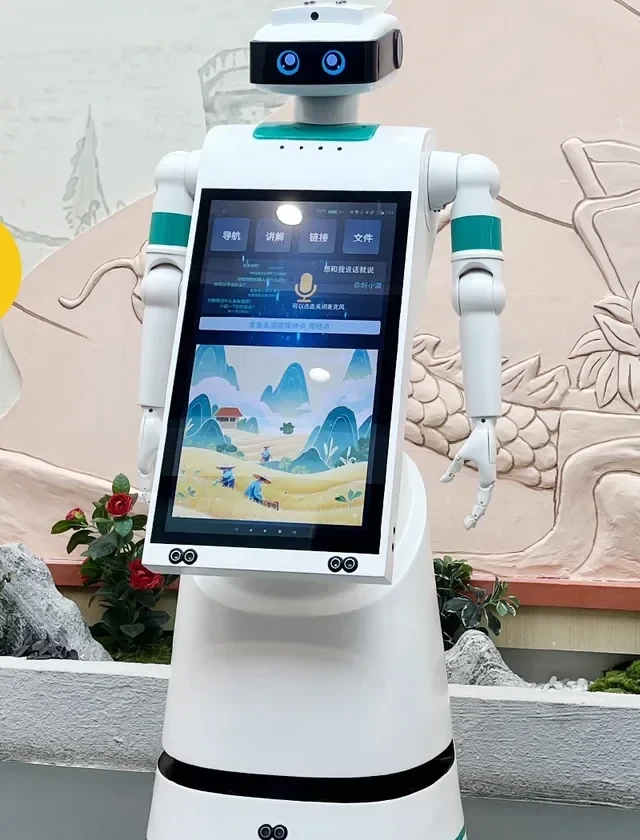
- Welcome and wayfinding — the robot greets, answers common questions and points to the lift, restaurant or meeting room.
- Concierge guidance — outlet directions, hotel information and multilingual conversation in the lobby.
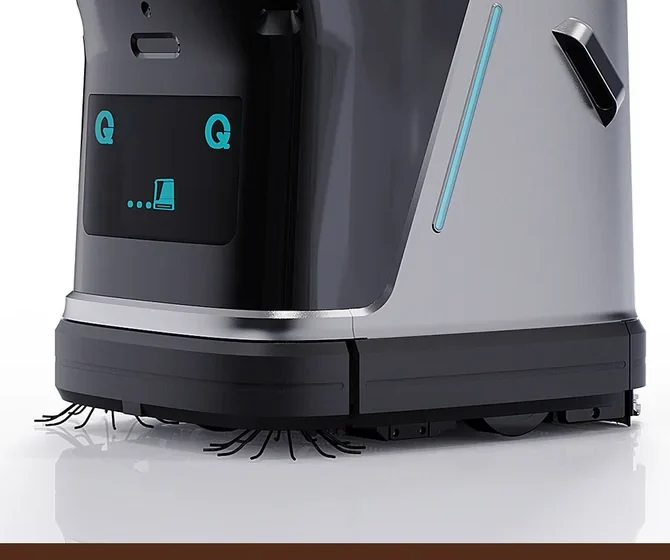
- Public-area cleaning — sweeping, scrubbing, vacuuming and dust mopping in lobbies, corridors and ballrooms.
- Luggage and goods transport — moving bags or back-of-house supplies on a fixed route.
- Food running — carrying trays in an outlet or banquet area, usually with staff serving the table.
The common thread is a repeatable route and a clear hand-off. If a task changes every time or needs a human judgment at the door, the robot will struggle.
Which types of hotel robots exist?
The seven types differ by task, guest contact and operating load. The table is a starting point, not a ranking.
| Type | Main task | Guest contact | Typical platform |
|---|---|---|---|
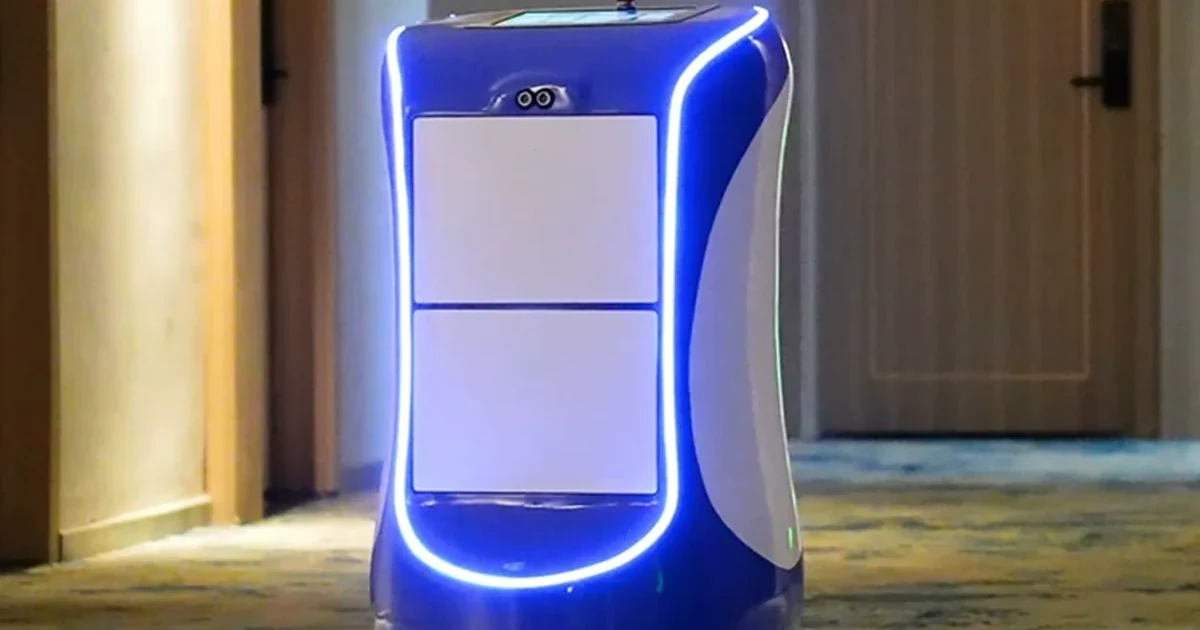
| Delivery robot | Amenities, towels, F&B and parcels to guest floors | Low to medium | AOBOTETE |
| Room service robot | Guest-triggered delivery with phone or app notification | Medium | AOBOTETE |
| Reception robot | Welcome, check-in support, wayfinding and FAQs | High | baluo-3.0 |
| Concierge robot | Guidance, recommendations and multilingual answers | High | baluo-3.0 |
| Cleaning robot | Sweep, scrub, vacuum and dust-mop public areas | Low | Aobo Cleaning Series |
| Luggage robot | Bag and goods transport on a fixed route | Medium | Aobo Transport Series |
| Food-service robot | Tray running in outlets and banquet rooms | Medium | PEIQIAOBO |
A hotel does not need every type. Most properties start with delivery because the task is frequent, light and easy to measure. Lobby robots come later, when the guest-flow problem is separate from the delivery problem.
What does a hotel robot cost?
Every project is quoted per configuration and scope. The unit and integration are only part of the project; freight, duty, training and spares are separate lines. Contact us for a current quotation.
| Cost line | What it covers | How it is quoted |
|---|---|---|
| Unit | Platform, standard configuration, screen, language pack, 12-month warranty | Deposit plus balance |
| Lift integration | Controller interface, relays or API work, testing | After a lift survey |
| PMS / PABX connector | Read-only room status, task reference, guest notification | After a technical call |
| Freight and duty | Shipping, insurance, import duty, VAT, clearance | Per shipment and destination |
| Training and spares | Staff training, documentation, recommended spare kit | Included or optional |
A single delivery unit with lift integration is usually the lowest-cost pilot. The hotel robot price guide breaks down the landed cost, and the ROI calculator turns the price into a payback estimate.
Where do hotel robots fail?
The failures are rarely about the robot’s ability to drive. They are about the building and the workflow:
- The lift exception was never tested. The normal call works; the busy lift, door obstruction and fire-mode simulation do not.
- The Wi-Fi has a dead spot. The corridor corner or lift lobby loses the task update.
- No one owns the queue. Tasks sit in the console because the front desk assumes someone else is watching.
- Staff bypass the robot in week one. The old habit is faster during the learning curve, so the robot never reaches volume.
- The PMS scope grows. A read-only connector becomes a write-back project without a change order.
The prevention is a test script, a walk test, a named owner, a pilot target and a written scope. The deployment checklist lists the tests; the elevator integration guide and PMS integration guide explain the two integrations that cause most delays.
Is a hotel robot worth it for a small hotel?
A small hotel should start from the delivery log, not from the room count. If the property handles 15 to 30 room deliveries a day, one unit can take a meaningful share. If it handles five, the robot will spend most of the day idle and the payback case disappears.
For a small property, compare three options: one delivery unit, a smart locker for uncollected items, and a shared staff runner. The 100-room hotel pilot plan shows the sizing arithmetic; the serviced apartment solution shows a layout with a compact service core.
How does a hotel robot work?
The robot builds a map with LiDAR and depth cameras, localises itself against that map, and plans a route around people and obstacles. A task queue tells it what to carry and where to go. At the lift, it requests a car through a dry-contact relay, a serial link or an API, then waits for the floor. At the door, it calls the room phone, sends an app notification or shows a code on its screen.
The workflow only works when the map, the network and the lift rule are stable. The delivery robot guide walks through the six-step workflow; the delivery platform page lists the specifications.
How do you choose a first robot?
Use five steps:
- Log the task for one week. Count deliveries, times and staff minutes.
- Pick one task. Amenity delivery is the usual first choice.
- Survey the building. Lift controller, Wi-Fi coverage, door widths and charging point.
- Pilot one unit for two to four weeks. Measure tasks, round-trip time, exceptions and staff time released.
- Expand only after the route is stable. Add a shift before adding a second unit.
The buying guide covers the RFP and acceptance test. The supplier page explains factory-direct and OEM options; the factory page shows how the units are built and checked.
Where to go next
- Compare the hotel delivery robot and reception robot platforms.
- See the full product range and the factory catalogue with model specifications.
- Read the hotel robot price guide before requesting a quote.
- Estimate fleet size and payback with the ROI calculator.
- Check the deployment checklist before the site visit.
- Send the property details through the contact page.
- For a quick answer, message the factory on WhatsApp.
The right first question is not “which robot is best?”. It is “which task costs the property the most walking time?”. Start there, and the category becomes much smaller.