
Solution / City hotel
Hotel robots for a 100–180 room city hotel
Response within 24 hours · Warranty: 12 months
Reviewed by Aobotics Project Team
Quick answer
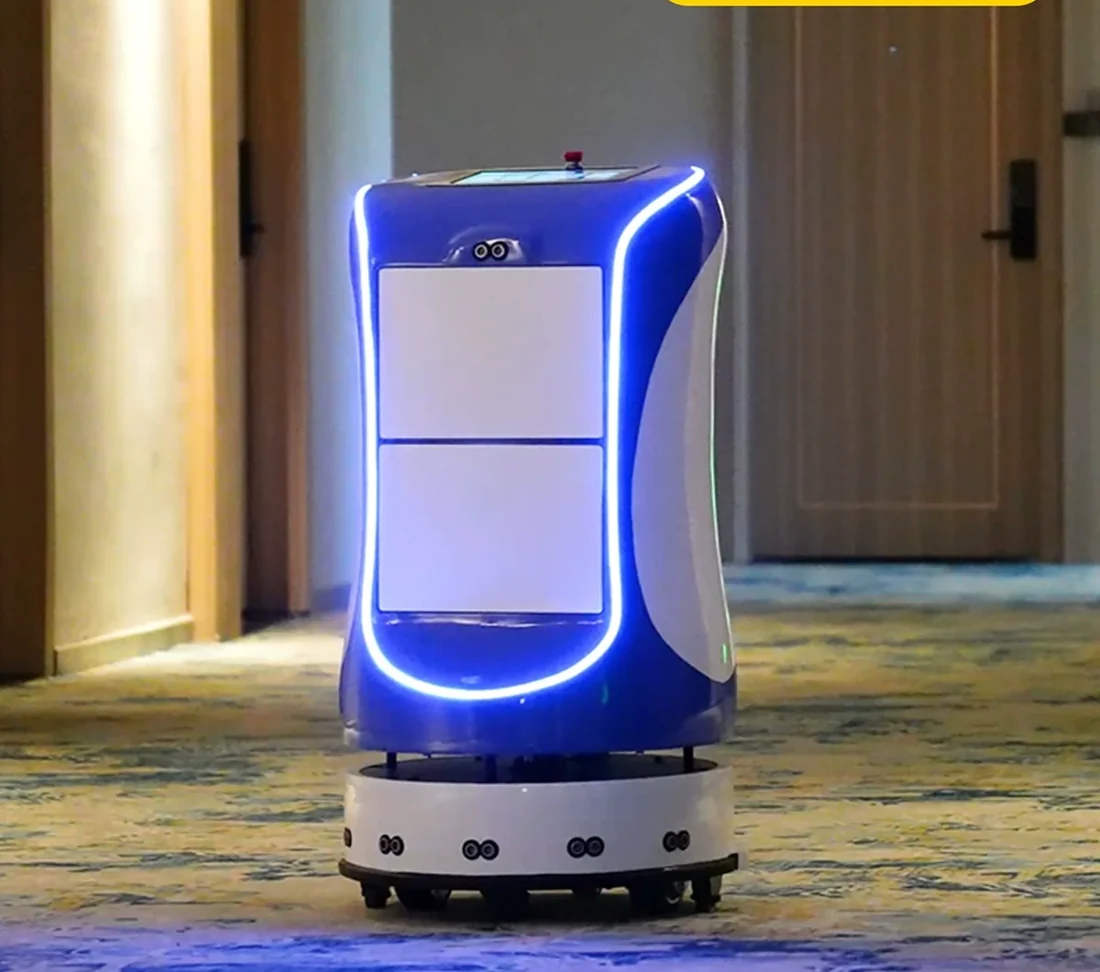
A city business hotel usually starts with one delivery robot on a dedicated service lift, covering amenity, towel and late-night F&B runs. A 100–120-room property can pilot with one unit; 150–180 rooms often need two for shift coverage. Reception is added only if the lobby has a wayfinding problem.
- Typical room count
- 100–180
- Pilot units
- 1–2
- Service lifts, typical
- 2
- Warranty
- 12 mo
Profile
What does a city hotel need from a robot?
Speed and reliability at the two daily peaks.
A city hotel has a concentrated breakfast peak, a late-afternoon amenity peak and a late-night request window. The robot’s value is highest when the front desk is busiest and the walk to the service core is longest.
The service lift is the bottleneck. A dedicated lift with a clear priority rule keeps the robot out of guest cars and makes the round-trip time predictable. If the property only has a shared lift, the pilot should run outside peak hours first.
Fleet size
How many robots does a city hotel need?
Start with the daily request count.
Planning assumptions, not measured results. Confirm with the front-desk log and the lift survey.
| Rooms | Daily robot tasks | Round-trip time | Robots for one shift | Shift coverage |
|---|---|---|---|---|
| 100 | 20–30 | 10–12 min | 1 | One shift; staff fallback |
| 120 | 25–35 | 10–12 min | 1 | One shift with peak cover |
| 150 | 35–50 | 10–12 min | 2 | Two shifts or peak redundancy |
| 180 | 45–60 | 10–12 min | 2 | Two shifts with charge rotation |
Lift rule
What lift rule works in a city hotel?
Dedicated service lift, off-peak guest lift, or manual fallback.
- Preferred: dedicated service lift with robot priority and a manual override.
- Acceptable: shared service lift with a peak-hour exclusion window.
- Compromise: guest lift at off-peak times with a staff escort.
- Fallback: staff-assisted lift if no automatic method is viable.
Pilot
What should the pilot measure?
Four numbers decide whether to expand.
| Metric | Target question | Review |
|---|---|---|
| Tasks completed | Is the robot doing the volume? | Daily |
| Average round-trip time | Is the lift rule working? | Weekly |
| Exception rate | How often does a human rescue it? | Weekly |
| Staff time released | Is the front desk feeling relief? | End of pilot |
Frequently asked questions
Frequently asked questions
Response within 24 hours · Talk to an engineer
Can one robot cover 24 hours?
Not continuously. The robot needs charging and cleaning. One unit can cover one main shift with a charge window; two units provide shift coverage and redundancy. The property should plan the charge window outside the peak request period.
Do we need a dedicated service lift?
It is strongly preferred. A dedicated lift makes the round-trip predictable and avoids guest friction. A shared lift can work with a priority rule and an off-peak schedule, but the pilot should measure the lift wait.
Where should the robot charge?
In the service core, near housekeeping, with a dedicated power point and a clear floor marking. Do not charge in a guest corridor or an egress path.
What is the best first task?
Amenity and towel delivery. It is frequent, light, predictable and easy to measure. Add late-night F&B after the route and the lift rule are stable.
How long is the pilot?
Two to four weeks. The first week tunes routes and lift rules; the second week measures exceptions; the remaining time tests peak coverage. Decide on expansion after the review, not on the first good day.
Aobotics
Size a city hotel pilot
Send the room count, lift count and daily request volume.
- Response within 24 hours
- Talk to an engineer
- Warranty: 12 months
Tell us about your property
Share your property and the task. We reply with a configuration and a scoped quotation within 24 hours.